
TESLASUIT — Overview
TESLASUIT is a smart full-body suit created as an interface between a user and a digital environment. It brings together three distinct technologies in a single wearable garment, so that a person can both act inside a virtual or augmented world and feel that world act back on them. While the motion-capture system creates the user's avatar in VR, the haptic system simulates interaction with digital objects by stimulating skin and muscle nerves with electric impulses. A dedicated optical sensor monitors heart activity.
The three systems are:
- Haptic feedback — tactile sensations delivered through electrodes using electrical muscle stimulation (EMS) and transcutaneous electrical nerve stimulation (TENS). Both stimulate nerves through the skin with electric impulses; they differ in the parameters of the signal and the effect it produces. See Concept - Haptics.
- Motion capture (mocap) — full-body tracking that records the user's pose, position, and movements and turns them into a digital avatar. Tracking comes from inertial sensors distributed across the body. See Concept - Mocap.
- Biometry — measurement of parameters related to heart activity, derived from an optical photoplethysmography (PPG) sensor. See Concept - PPG.
System at a glance#
Physically, TESLASUIT is two garments — a jacket and trousers — each carrying its own set of mocap sensors and electrodes. Those sensors and electrodes are driven by nodes, electronic modules that manage the haptic, mocap, and biometry systems within a specific body area. The jacket houses the control unit, the main element that processes information from all the nodes, contains the internal Wi-Fi module, and provides the connection to a host PC. Power comes from a portable power bank that sits in a dedicated pocket on the back of the jacket.
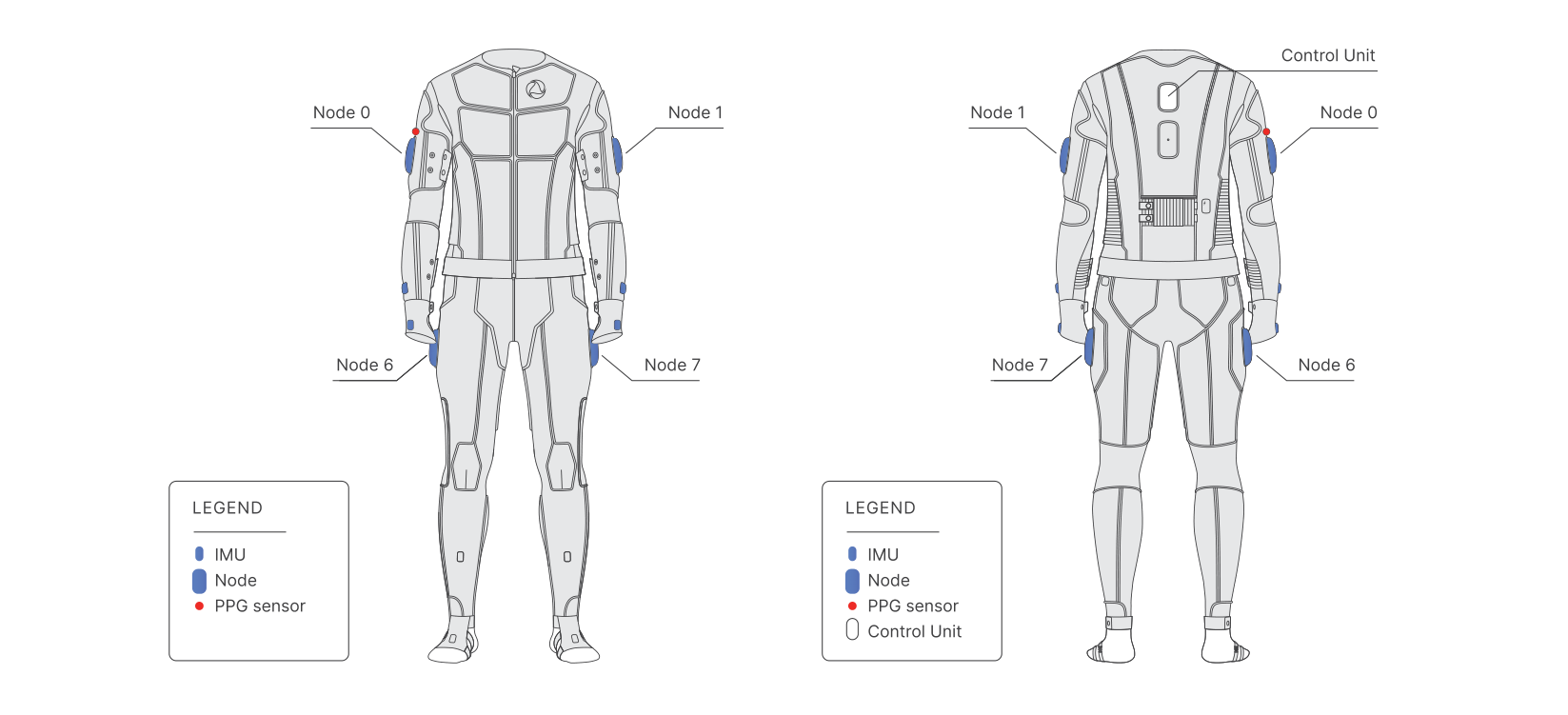
| System | Hardware | Concept |
|---|---|---|
| Haptic | 114 electrodes → 80 channels | Concept - Haptics |
| Mocap | 14 IMU sets | Concept - Mocap |
| Biometry | 1 PPG sensor | Concept - PPG |
How the pieces fit#
The control unit coordinates the nodes; each node, through its commutation module, selects which haptic channels are active in its area. Haptic feedback is delivered across 80 channels — pairs of shaped electrodes placed in anatomically suitable locations — while the 14 IMU sets feed the avatar and the single PPG sensor feeds biometry.
Where to go next#
- Hardware - Getting Started — unbox and prepare
- Hardware - Components — the anatomy of the suit
- Hardware - Safety — read before first use
- Control Center - Overview — the software you pair and calibrate with